
The Bonus Double Standard
December 17, 2025
At 175 East Delaware Pl HOA, contract staff receive two bonuses while the direct HOA employees receive one, a disparity that raises fundamental questions about equality and board oversight. Voluntary owner-funded donations create one bonus distributed to all workers, but a second bonus paid by the Association goes exclusively to the property management’s contract staff, leaving maintenance, door staff, and receiving room team members with the short end of the stick. The good news is the board can, and should, authorize an equivalent second bonus for direct HOA employees immediately. This is an account of what happened when one member asked them to do exactly that.
Brought to you by Drew McManus, your neighbor in 7908.
Two Is Greater Than One
Understanding the Imbalance
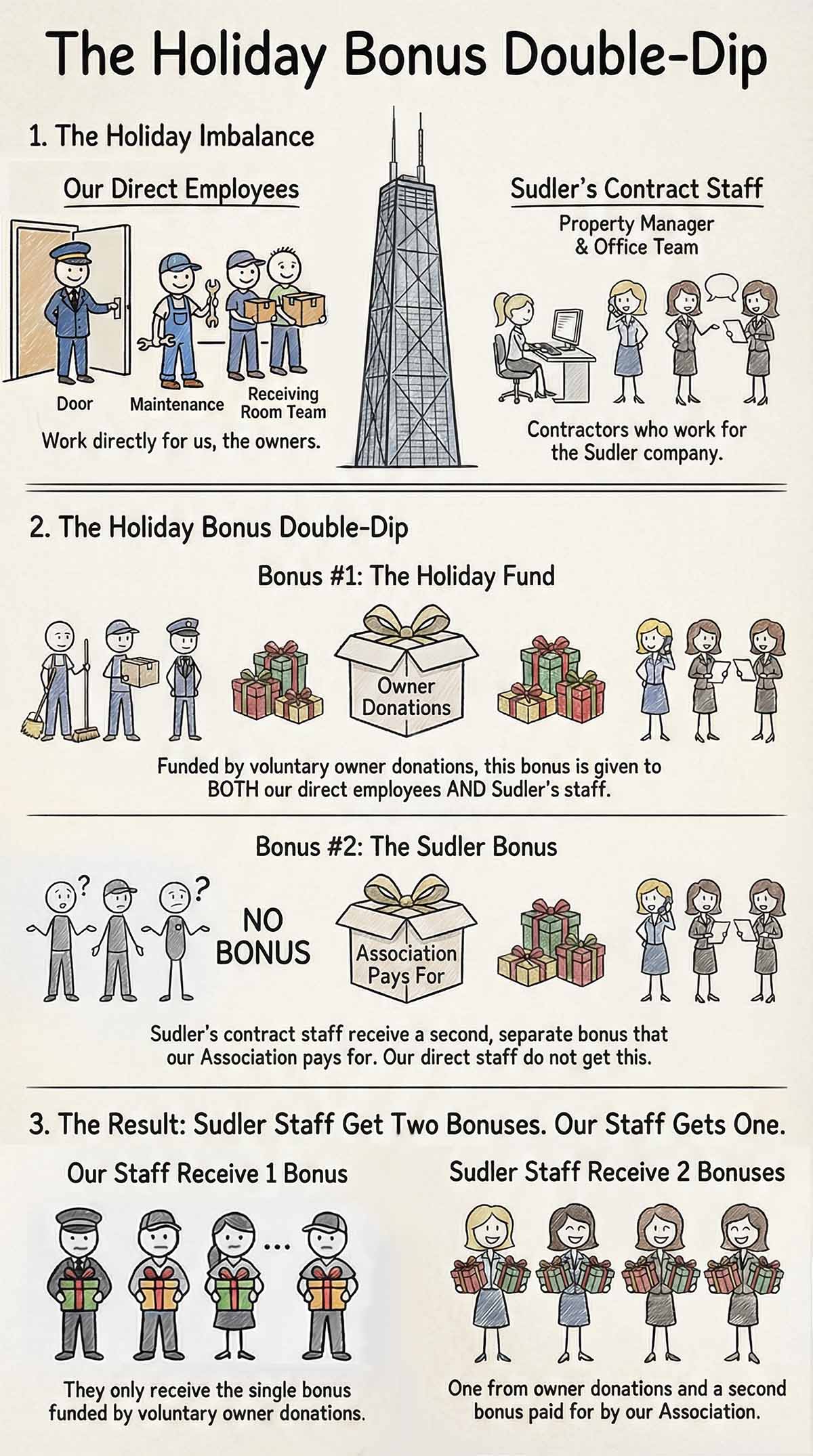
The situation breaks down simply: our building employs two categories of workers. Direct HOA employees (maintenance staff, doormen, receiving room personnel), work for us, the owners. Contract staff (property managers and office teams) work for Sudler, our management company.
When the holidays arrive, voluntary owner donations fund Bonus #1, distributed equitably to everyone. Then comes Bonus #2: the Association writes a check to Sudler for their contract staff. Our direct HOA employees receive no equivalent Association-funded bonus.
To be clear: the contract staff absolutely deserve their bonuses, they work hard and contribute to our building’s operations as much as the Association’s direct employees. The issue isn’t that they receive Association-funded recognition; it’s that our direct employees don’t receive the same.
What The Union Contract Actually Says
Board President, Scott Timmerman, cites union regulations as an obstacle but this concern evaporates under scrutiny. Union contracts govern minimum wages, benefits, and working conditions, they don’t prohibit bonuses. Buildings across Chicago with unionized staff provide holiday bonuses paid directly by their Associations every year without incident. The suggestion that union membership prevents bonus compensation is either a misunderstanding of labor law or a convenient deflection.
What’s missing isn’t procedure, it’s will.
Here’s what the actual union contract by and between the Apartment Building Owners and Managers Association of Illinois and the Service Employees International Union, Local 1 Residential Division covering door staff, receiving room employees and others says about bonuses, word for word:
Section 6:
“Any payments made by the Employer which are in excess of the wage rates established under this Agreement and which are made at its discretion shall be considered as bonus payments and shall not be considered as a part of the established wage rate hereunder for that employee, provided, however, that such payments shall not be deemed to be bonus payments unless the Union is informed of the bonus by the Employer.”
TL;DL: The Association can pay bonuses whenever it wants. The only requirement is telling the union about it.
What This Clause Actually Means
This language exists because union employees traded something away during contract negotiations. They gave up a guaranteed minimum bonus—the kind some contracts include where employees automatically receive, say, $500 or $1,000 every December regardless of circumstances. In exchange for that concession, they got protection.
The protection works like this: when the Association decides to pay a bonus, it can’t later claim that bonus was actually part of the regular wage rate. Why does that matter? Because if bonuses became part of the wage calculation, the Association could theoretically give someone a $1,000 bonus in December, then argue that next year’s contractual wage increase should be reduced by that amount. The employee would end up right back where they started.
This is the kind of maneuver unions exist to prevent.
What The Clause Doesn’t Say
Notice what’s missing: nowhere does Section 6 prohibit bonuses. Nowhere does it require board votes, special procedures, or elaborate approval processes. Nowhere does it say bonuses create labor complications or legal exposure.
The contract does not assume bonuses will happen. It just makes sure they happen fairly.
Why This Language Exists at All
Union contracts get negotiated line by line. Every clause represents a compromise. When employees agree to contract language about discretionary bonuses instead of guaranteed bonuses, they’re accepting uncertainty, maybe they get a bonus this year, maybe they don’t. Management gets flexibility; employees get protection against exploitation of that flexibility. In short, it’s a concession on the part of employees.
The protection matters because discretionary bonuses create asymmetric power dynamics. Management controls when bonuses happen and how much they are. Without contractual guardrails, that discretion could become a tool for undermining negotiated compensation. Give generous bonuses one year, then argue those bonuses justify smaller raises the next year. The math works out the same for the Association’s budget, but employees lose the security of predictable, guaranteed wage growth.
Section 6 prevents that scenario. It says: bonuses are extra. They’re separate. They don’t contaminate the wage structure or become ammunition in future negotiations.
The Single Requirement
The contract imposes exactly one obligation on the Association: inform the union when bonuses are paid. That’s it. Not ask permission. Not negotiate terms. Not submit to arbitration. Just send a notification.
This requirement serves an obvious purpose, the union needs to know about bonuses to verify the Association isn’t playing accounting games later.
An Unconscionable Double Standard
Union employees gave up guaranteed bonuses during negotiations in exchange for discretionary ones. Now that concession is being weaponized against them and are being told the very flexibility they granted prevents bonuses entirely.
Meanwhile, Sudler’s contract staff receive Association-funded bonuses without question or scrutiny. At 175 E Delaware Pl HOA, the board doesn’t even know how the bonuses were distributed or if some of the funds went to Sudler’s senior executives.
The message is clear: sacrifice gets punished.
If the union contract actually prohibited bonuses, board leadership should cite the specific provision. They won’t, because Section 6 explicitly authorizes discretionary bonuses. The board has the authority and the contract permits it.
What This Means For Your Building
If you live in another Chicago high-rise, examine your own bonus structure. Contract management companies operate across hundreds of buildings. The incentive structure that created this disparity at 175 East Delaware Pl HOA exists elsewhere.
The broader principle extends beyond bonuses. When boards defer compensation equity questions, they’re making a statement about whose work they value.
Maintenance staff keep buildings functioning. Doormen provide security and service. Receiving room teams manage the daily logistics that make urban residential life possible. These roles are no less valuable than competent, efficient management staff.
Taking Action At 175 East Delaware
Owner action changes board priorities. Silence enables inertia. The form below provides direct communication with your board, please use it.
Doing the Right Thing at 175 East Delaware
At the December 15, 2025 board meeting, member Jason Mattis proposed the following motion:
I’m pleased to report the board approved the motion.
Presented with clear evidence of compensation inequity, straightforward legal analysis, and a reasonable path forward, the board acted decisively to correct it.
The vote demonstrates several things worth celebrating.
- It shows the board takes seriously their fiduciary duty to all stakeholders in the building, not just the management company.
- It proves that when presented with facts rather than deflection, governance bodies can cut through procedural excuses and focus on substance.
- It sends an unmistakable message to every person who works in our building: your contributions matter and will be recognized equitably.
This wasn’t a difficult decision legally or financially. The union contract explicitly permits discretionary bonuses. The cost per owner doesn’t even amount to the price of a casual dinner for one person. What it required was ethical clarity and the willingness to do what’s right even when it means questioning existing practices and pushing back against the current leadership.
The board provided that clarity. They deserve credit for it.
Thanking the Board
If you’re pleased with this decision, the board should hear from you. Recognition of good governance matters just as much as accountability for poor decisions. Here’s a template letter you can send:
A Missed Opportunity at 175 East Delaware
At the December 15, 2025 board meeting, member Jason Mattis proposed the following motion:
Rather than vote on the motion directly, board member Lenore Holt-Darcy proposed referring it to the Finance Committee for review. It was seconded and the majority of the board approved her motion by voice vote.
The Finance Committee doesn’t typically meet until June. The proposed bonus had a March 1, 2026 deadline. What does that math tell you?
When the motion returns from committee review, assuming it does, the timeline specified in the original proposal will have expired. The bonus meant to address this year’s holiday disparity will be rendered moot by the calendar.
The board was presented with a clear opportunity to correct an obvious inequity. The math was straightforward, the legal pathway was clear, and the ethical question was direct. Rather than vote yes or no, the board chose a third option to delay and extend the disparity.
By a narrow margin, the board voted to discuss the matter in closed session, shielding their deliberations from owner observation. What rationale was offered, what concerns were raised, what objections were voiced, owners don’t know. What we do know is the outcome: referral to a committee with no clear mandate that doesn’t meet until three months after the proposed payment deadline.
The people who keep our building running, who respond to maintenance emergencies at 2 AM, who provide security and service every day, who manage the complex logistics of a high-rise deserved better. They made concessions during union negotiations that gave the Association discretion over bonuses. That discretion has now been weaponized against them. Is that what you call leadership?
This isn’t complicated economics or nuanced labor law or nuanced labor law requiring months of specialized analysis. The question is whether two groups of workers doing comparable work in the same building should receive comparable recognition from the Association.
Seeking Accountability
After the December 15 meeting, I reached out to each board member individually via email. The motion had been referred to the Finance Committee via voice vote, which meant the recording captured no individual votes. As such, I asked three straightforward questions so owners can know exactly where each members stands:
- If the original motion to authorize the employee bonuses had come to a vote, would you have voted for it or against it?
- How did you vote on the counter-motion introduced by member Holt-Darcy to refer this matter to the Finance Committee?
- If you have any individual perspective you wish to share on this issue of authorizing direct HOA employees a bonus equal to what is authorized for contracted staff of the management company, offered solely in your capacity as an individual owner and not as a statement on behalf of the Board, please feel free to include with your response and it will be included in the article unedited and attributed to you.
I provided a deadline of 8pm CT on Tuesday, December 16, 2025 for the article’s Wednesday publication.
As of publication, not one board member has replied.
What does the silence tell you? When given the opportunity to publicly state their position on whether our building’s workers deserve equitable treatment, even when speaking as an individual owner, members chose not to respond. They voted to discuss the matter behind closed doors, then declined to explain their reasoning to the owners they represent.
If you find this sequence of events troubling, the board needs to hear from you. Here’s a form you can use and customize that will be delivered directly to each board member: